Capsicum annuum.
The long pepper of the American Southwest — become the pillar of the cuisine of New Mexico, Arizona and California. The modern history of the variety hinges on one man: Emilio Ortega, a Californian farmer who in 1894 brought back pepper seeds from New Mexico, where he had spent a few years studying traditional Hispano-Mexican cooking. He planted them in his field at Anaheim, in the suburbs of Los Angeles, and founded the first commercial green-pepper cannery in North America — the company Ortega still exists today.
The variety took the name Anaheim from the city where it was commercialized, but its true roots are further east, in the Hatch Valley of New Mexico, where related varieties (often called "New Mexico chiles" or Hatch chiles) have been cultivated by Hispanic and Indigenous (Pueblo) communities since at least the 16th century.
On the Scoville scale, Anaheim ranks among the mildest of hot peppers: only 500 to 2,500 units — clearly less pungent than jalapeño (up to 8,000) or serrano (up to 25,000). It's the hot pepper you can eat in large quantities without going up in flames.
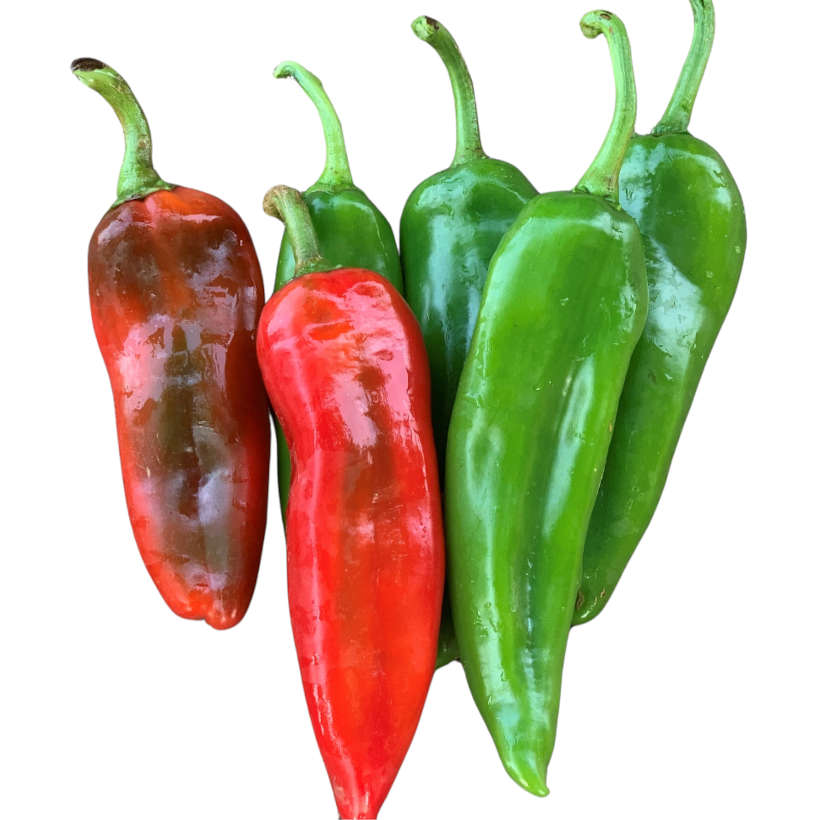
A vigorous, well-held plant 60 to 90 cm tall, which produces in peak season 15 to 25 long fruits 15 to 20 cm by 4 to 5 cm wide, with fleshy walls (among the meatiest of peppers). Classic ripening from deep green to scarlet red. Exceptional flavour: sweet-pungent, fruity, terribly aromatic, with a lightly smoky note even raw (which amplifies magnificently in cooking).
Signature preparation that defines New Mexico cuisine: roasted and peeled green chile. Grill whole peppers directly over the barbecue flame or under the broiler until the skin is blackened and blistered; put the hot peppers in a paper bag or covered bowl for 10 minutes (steam loosens the skin); peel by hand under a thin stream of cold water. The result — melting, perfumed, smoky flesh — is the base ingredient of almost all the green cuisine of New Mex: chile relleno (whole roasted pepper, stuffed with cheese, dipped in beaten egg and fried), green chile stew (meat stew with green chile), green enchiladas, huevos rancheros, "California" burger sauce. Also excellent dried whole and hung in a ristra (string of air-dried peppers — the classic autumn ornament of homes in the American Southwest) for winter use.
Grower's tip: Like all peppers already described, indoor start 8 to 10 weeks before last frost, at 25-28 °C on a heat mat. Transplant once nights are stable above 12 °C (early to mid-June in Québec). Anaheim asks for a slightly longer season than jalapeño or serrano — harvest at 75-85 days for green fruits, or wait 100 days for red. The harvest baskets are impressive: the large fruit size and the plant's productivity mean a single plant can easily yield 2 to 3 kg of peppers over the season. For freezer storage, the winning technique: roast and peel the peppers as described above, then freeze spread on a sheet pan and transfer to airtight bags — keeps 12 months without significant loss of flavour or texture.
- Open-pollinated. American-Southwest heirloom variety (1894). Largely self-fertile, but crossings possible with other Capsicum annuum nearby — isolate or bag flowers for seed saving.
- Height: 60 to 90 cm.
- Maturity: 75 to 85 days after transplant for green fruits, 90 to 100 days for red.
- Exposure: full sun, warmth.
- Rich, well-drained, warm soil. Space plants 50 to 60 cm apart.
- Indoor start 8 to 10 weeks before last frost. Transplant once all risk of frost is past (early to mid-June in Québec).