Althaea officinalis.
A name that opens a small, savoury time-portal — the white and sticky marshmallows toasted over a campfire originally come from this plant. Not directly from the ones you buy in a bag at the grocery store, which haven't actually contained any plant extract for a long time (just sugar, corn syrup and gelatin), but rather from the original confection, as it was prepared since pharaonic Egypt: a mucilage extracted from the plant's roots, mixed with honey or sugar, whipped into an airy foam and offered as a soothing remedy to irritated throats and stubborn coughs. The Latin name itself, Althaea, comes from the Greek althein, "to heal" — that tells you the place it held in ancient pharmacopoeia. Pliny the Elder, Dioscorides, the Arab doctors of the Middle Ages, all attributed to it emollient and wound-healing virtues that modern science validates for treating mild inflammations of the mucous membranes.
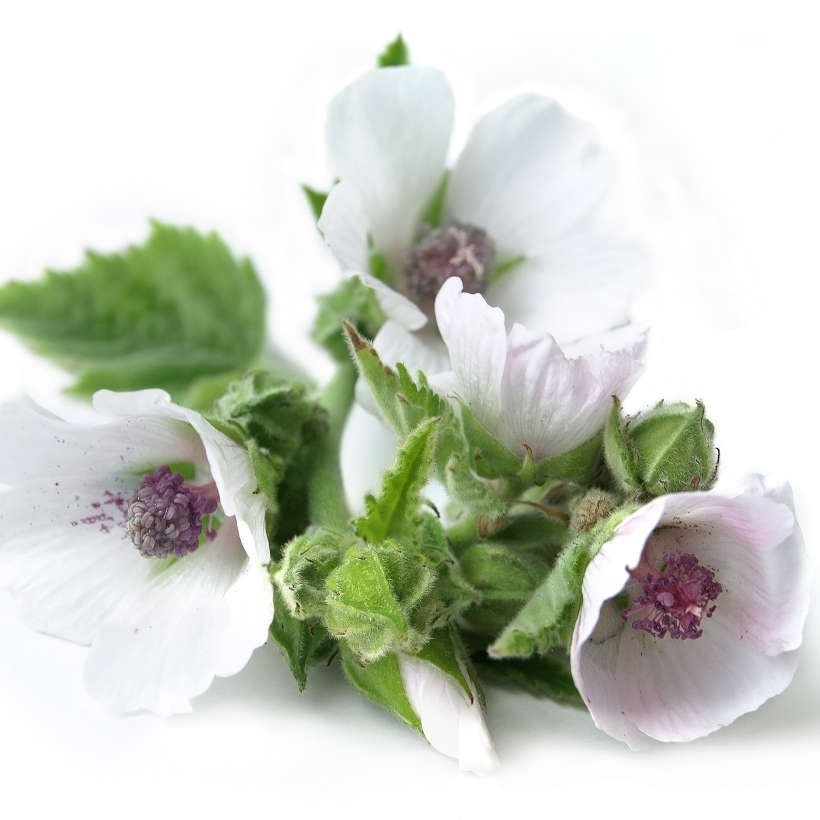
A hardy perennial of great beauty, native to the wetlands and brackish marshes of Europe and western Asia (hence the English name marsh-mallow). An imposing plant 1 to 2 m tall at full maturity, with velvety leaves of an almost downy silver-green that give the plant a tactile softness rare in the garden, crowned all summer with five-petalled cup-shaped flowers of a very pale pink-white — elegant, melliferous, particularly attractive to bumblebees. Multi-use: roots harvested in the second or third autumn to prepare decoctions, syrups and soothing infusions; young tender leaves edible raw in a spring salad (soft, slightly mucilaginous texture); decorative edible flowers, pretty in a still water or sprinkled on a dessert. A precious plant in the medicinal-plant garden and the wildflower garden.
Grower's tip: Capricious, slow germination — marshmallow needs a 4-to-6-week cold stratification in the fridge in a slightly damp sand bag before spring sowing, or more simply, an autumn sowing directly in place that lets winter do the work. First year rather modest in growth; second year, adult size and start of flowering; third year, full production. Choose a permanent spot where the plant can establish itself — it's a long-lived perennial (10 to 15 years). To harvest the root for medicinal uses, wait until the end of the second or third season, in autumn, after the above-ground parts have died back. Dry the roots cut into rounds in dry, warm air.
- Open-pollinated. Hardy perennial (zone 3). Insect-pollinated, especially by bumblebees.
- Height: 1 to 2 m.
- Flowering: July to September.
- Exposure: full sun to part shade.
- Rich, fresh, well-drained soil that never dries out completely. Tolerates slightly damp and even mildly salty soils (origin in marsh edges). Space plants 50-60 cm apart.
- Autumn sowing in place for natural stratification, or indoor sowing after 4 to 6 weeks of fridge stratification, 6 to 8 weeks before planting out.